/garage-jumpsuit
Mechanic Muse — Nine AI Photos
Make it with your museMechanic Muse — Nine AI Photos
Open this world on the wall, and make it with your muse.
all 9 frames of her, in this world ↓
The Garage Register: One Jumpsuit, Three Positions, and Light From Three Directions
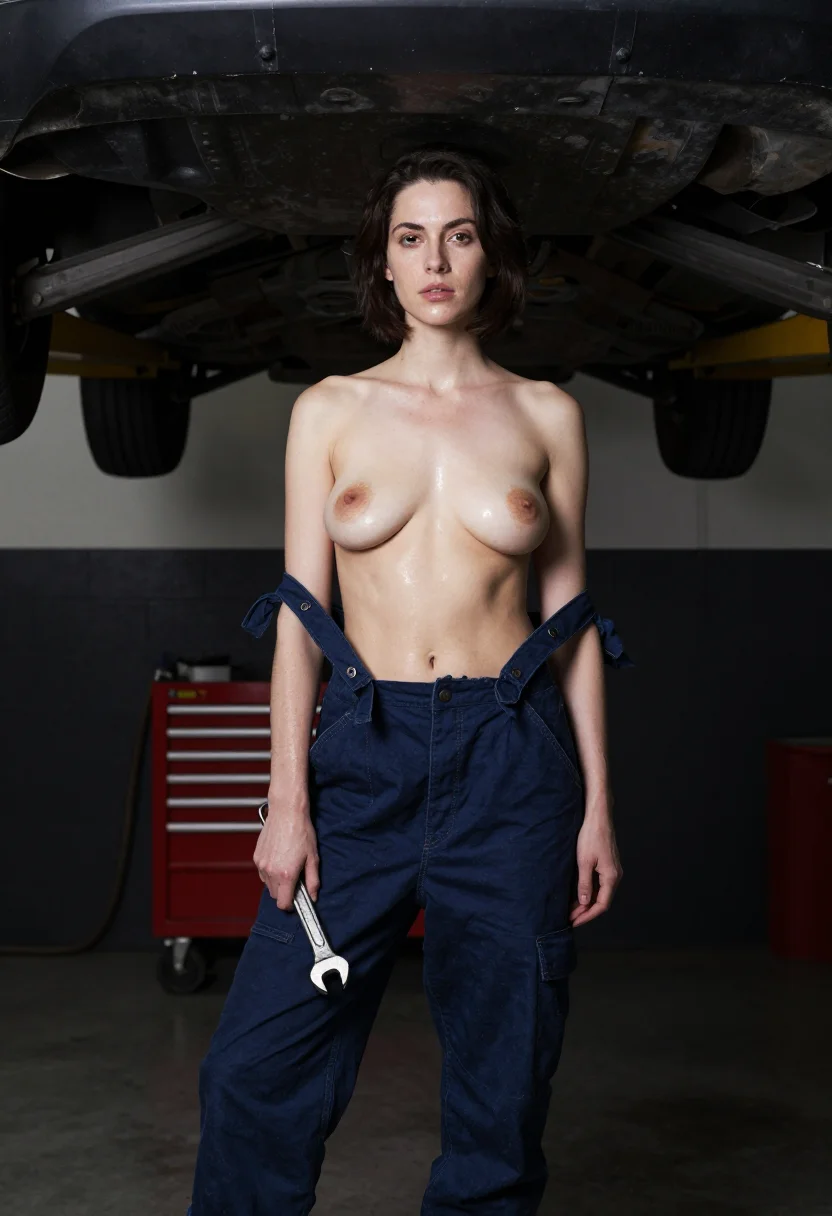
The mechanic's coverall is one of the few garments designed around a single fastening, and this pack is built on that fact. Navy cotton twill, a full-length front zip from throat to hip, patch pockets, a topstitched yoke, sleeves that push above the elbow, worn with scuffed brown leather boots and a knotted red bandana. The zip is the whole story: closed to the collar in the lift bay, the sleeves knotted at the waist at the parts counter, the top folded down to the hips at the night lot with the legs puddling over the boot tops. This is an auto shop photoshoot in the literal sense — the poses are working ones, not studio marks, and grease on a forearm is treated as texture rather than decoration.
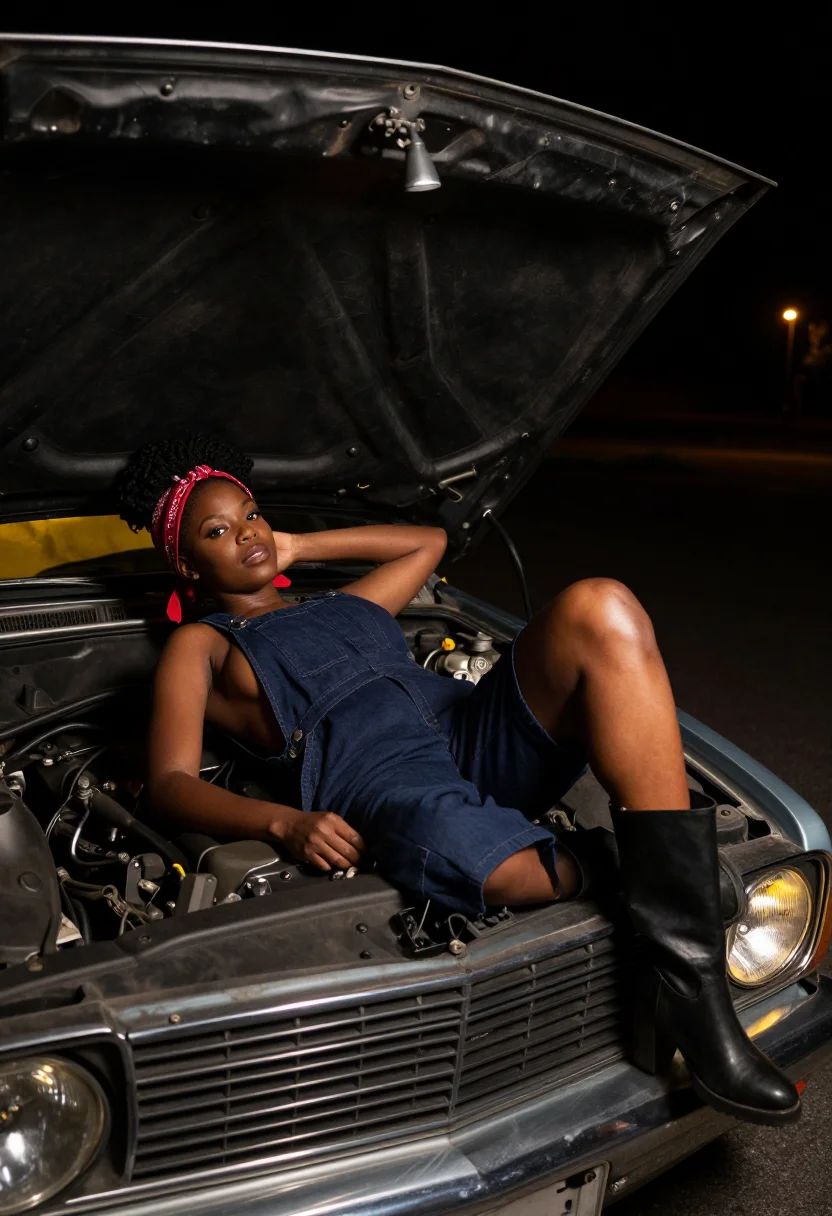
Three settings supply three genuinely different lighting logics, which is unusual for a garage series and is the reason to shoot one. Under a car raised on the lift, the source is narrow and overhead, squeezed between the blackened underbody and the floor: small, far, hard, landing only on up-facing planes with the bay corners falling to near-black and the lift's yellow posts running vertically at both frame edges. At the parts counter the source is a dusty bay window from the side: broad and near, wrapping a shoulder with a gradual shadow edge, holding detail across a full pegboard wall of hung spanners and sockets, each steel hook throwing a short soft shadow onto tan board. In the night lot the source is a drop-light hooked low over the engine bay, throwing hard yellow upward past the fender so undersides carry and everything beyond a couple of metres goes to flat black. Hard from above, soft from the side, hard from below — the same garment read three ways.
The muse is an AI invention built for the garage-mechanic register: the jumpsuit is cut and zipped before a pixel exists, and the figure is composed for this world from the ground up.
The house casts a range of muses across the nine frames — a pale grey-eyed muse with short dark hair pushed back, a deep-bronze muse with coiled hair bound under a red bandana, a pink-toned redhead with a loose braid over one shoulder — so the mechanic is a look rather than a single body. Every frame is AI-generated and photographic in finish: the hard shadow edge under the chassis, the soft specular off a dusty window, the yellow catchlight of a drop-light are rendered from photographic principles, not drawn.
Frequently asked questions
- What is in the AI Mechanic pack?
- Nine frames of a mechanic working one navy twill jumpsuit through three parts of a shift: the lift bay under a car raised overhead, the parts counter against a full pegboard wall of spanners and sockets, and a night lot with the hood up and a drop-light hooked low over the engine bay. The garment is constant — navy cotton twill, full-length front zip, patch pockets, topstitched yoke, scuffed brown leather boots. Three frames per setting.
- Who is she? Is this a real person?
- She's an AI muse — generated, synthetic, fictional. The jumpsuit is cut and zipped before a single pixel exists, and the figure is composed for this register from the ground up, with no real person behind her.
- What does the jumpsuit actually do across the nine frames?
- It travels. In the lift bay it is zipped to the collar and worn fully closed, the sleeves set at the shoulder. At the parts counter the sleeves are knotted at the waist, the top half falling over one hip like a working tool-belt. In the night lot the top is folded down to the waist with the sleeves hanging loose past the knees. One garment, three positions — that progression is the pack, which is why a boilersuit series reads as a shoot rather than nine unrelated images.
- Are these real photographs or AI-generated?
- AI-generated, and photographic in finish. The crisp edge hard overhead light draws along a shoulder, the weak soft shadows a dusty bay window throws across pegboard tan, the steep fall-off of a drop-light climbing from below — all rendered from photographic principles, so the result reads as working photography rather than an illustration.
- Why is the light so different in each setting?
- Because the garage supplies three genuinely different sources. Under the raised car the light is narrow and comes from overhead between the chassis and the floor: small, far, hard, landing only on up-facing planes with the bay corners at near-black. At the parts counter it is broad daylight through a dusty bay window: large and near, wrapping the body with a gradual edge, detail held right across the frame. In the night lot a drop-light hangs low and throws hard yellow upward, carrying undersides and leaving everything past a couple of metres black. Hard from above, soft from the side, hard from below.
- Is this a pin-up calendar pack?
- No — that is the deliberate difference. The garage pin-up calendar posed a model against a car she was not working on. Here the poses come out of the work: a wrench held loose along a thigh, both hands up in an underbody, a body lying on a wheeled creeper board half slid out from under a lift, a finger holding a place in an open parts book. If you want the painted-calendar register instead, the Carhop pack is the 1950s pin-up one; Last Call is the after-hours bar; Secretary Desk is the mid-century office.
- How is this different from a typical AI image generator?
- Adjacent, different format. A typical generator is a chat or a text box where you steer one image at a time and keep the wardrobe consistent yourself. This is a pre-engineered nine-frame series — one jumpsuit, three coordinated settings, three lighting logics — delivered as a single purchase.
- Is there an age requirement, and is a real person depicted?
- Access requires confirmation of age (18+). No real person is named, depicted or impersonated anywhere in this pack; every muse is AI-generated.
- Who is in the photos?
- A muse you choose. 32 AI faces, none of them a real person.
Who Reaches for the Garage Register
- Anyone searching female mechanic photos, garage photoshoot or jumpsuit photoshoot who wants the register shot properly — navy twill, a real zip, real tools — as a composed AI photoshoot
- People who want a car garage photoshoot where the car is genuinely on a lift and the hood is genuinely open, not a backdrop
- Photographers and lighting students studying one figure under three sources: narrow hard overhead, broad soft side daylight, and hard uplight from a drop-light
- Artists researching workwear construction — coverall zips, patch pockets, topstitched yokes — and shop-floor material culture: pegboard, creeper boards, lift posts, oil-stained concrete
- Writers and screenwriters who need a consistent face for a female mechanic photoshoot or a fictional character working a shop floor
- Adults curious about AI portrait photography in a workwear register at an accessible entry price
About Ovid
Ovid is a house of pictures that were never taken. Most AI image tools ship one giant catalog of poses and aesthetics; the output looks like every other generated image on the internet. Ovid goes the other way. Each pack is a single editorial brief — light, styling, scene composed in the grammar of the great fashion editorials — hand-curated against real references and tested before it ships. Free preview before you pay. Packs are one-time. No template generator, no feed. A fashion house, not a catalog.