/geisha-patron-dinner
Geisha Dinner Portraits
Make it with your museGeisha Dinner Portraits
Open this world on the wall, and make it with your muse.
all 9 frames of her, in this world ↓
The Geisha Dinner Register
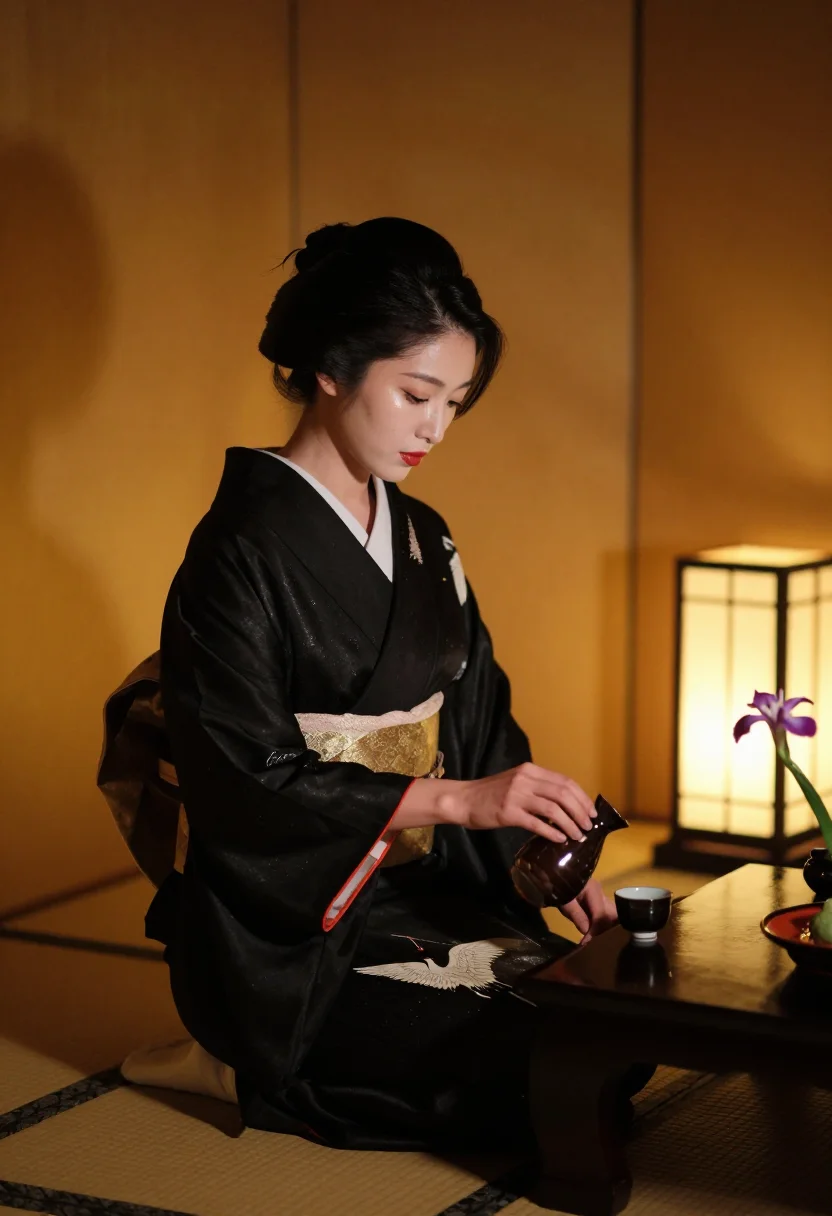
A geisha at a private dinner in a Kyoto teahouse: black kimono with white cranes, gold obi, white-painted nape, amber paper screens. The register rests on a black crane kimono, a gold brocade obi and sake from a ceramic flask, kept to one palette so the set reads as a single session.
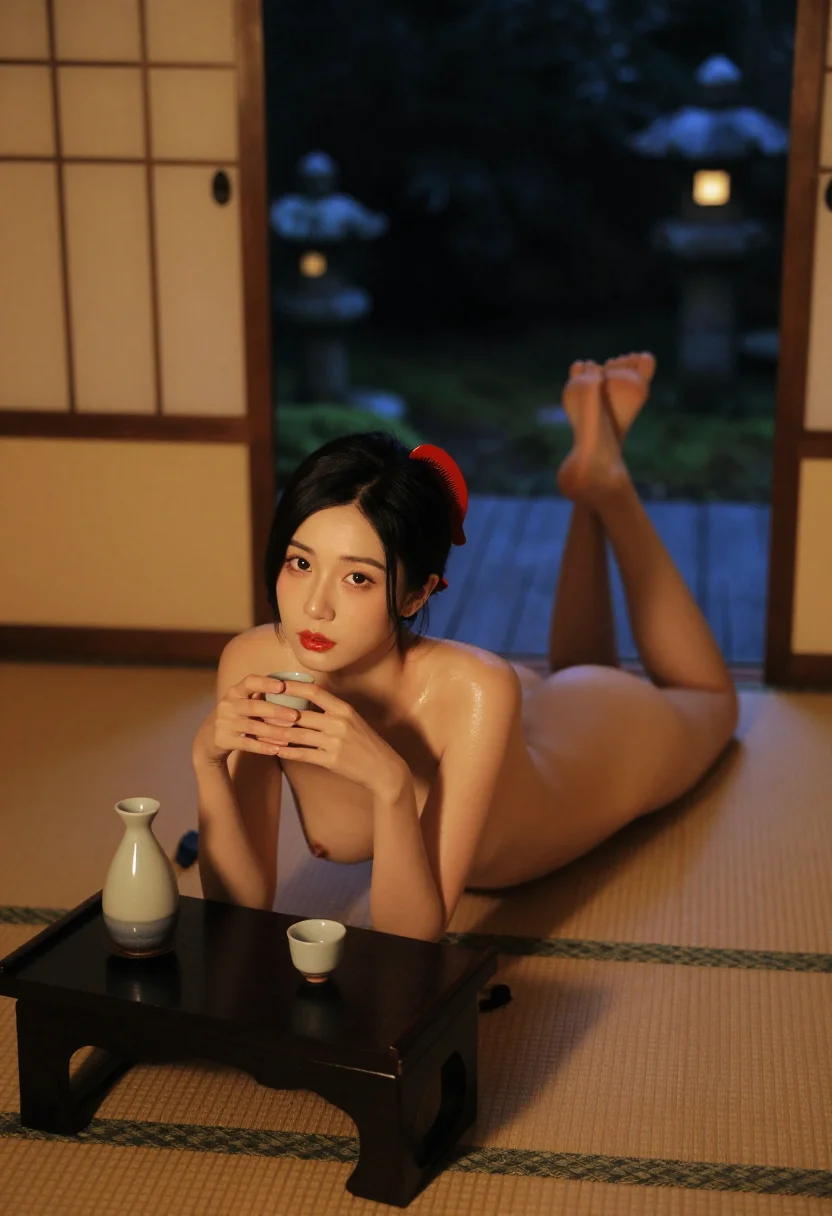
The arc moves in three clear stages, never mid-change: kneeling at the black lacquer table in the formal black silk kimono with white cranes on the hem and a broad gold brocade obi, pouring sake from a ceramic flask; then seated on the tatami in the same kimono with a silk haori added over the shoulders, looking back over one shoulder; then reclining on one elbow on the tatami beside the lacquer table in a patterned silk robe, a red lacquer comb in her hair, the sake cup in her fingers, the paper screen slid open on a garden of stone lanterns. Palette stays fixed throughout — black silk, gold obi, white nape, amber paper glow, one red — so the nine frames read as one session, not nine unrelated shots.
Every frame is photographic in construction — light, fabric drape, real skin texture — never drawn, never animated. The sake, the lacquer table and the comb hold through all three looks. Each frame is written as a brief before it is rendered and composed from the first pixel forward, which is what lets the set hold together.
Frequently asked questions
- What is in the Geisha Dinner Portraits pack?
- Nine frames in a private Kyoto teahouse room of lacquer and amber paper screens — a black crane kimono, a gold brocade obi and sake from a ceramic flask: kneeling at the black lacquer table in the formal black silk kimono with white cranes on the hem and a broad gold brocade obi, pouring sake from a ceramic flask; then seated on the tatami in the same kimono with a silk haori added over the shoulders, looking back over one shoulder; then reclining on one elbow on the tatami beside the lacquer table in a patterned silk robe, a red lacquer comb in her hair, the sake cup in her fingers, the paper screen slid open on a garden of stone lanterns.
- Are these real photographs or AI-generated?
- AI-generated, built on photographic principles: light, fabric drape and skin texture, never drawn and never animated. The sake, the lacquer table and the comb carry through the arc.
- Is this a real photo altered, or something else? What about age and compliance?
- Nothing is altered from an existing image. Each frame is written first — the setting, the wardrobe, the light, the pose — then composed from the first pixel forward. The muse is a composed adult, not a real person's photograph; if you cast your own face by selfie, that is your choice and your face. Access requires confirming you are 18 or over.
- How does the outfit change across the nine frames?
- It moves in three clear steps, never mid-change: the formal kimono with its obi, then the same kimono with a silk haori added, then a patterned silk robe. Nothing is caught halfway.
- What is the wardrobe and setting?
- A private Kyoto teahouse room of lacquer and amber paper screens. Palette: black silk, gold obi, white nape, amber paper glow, one red. The sake, the lacquer table and the comb stay through the arc.
- Is the patron in the pictures?
- No. The patron is never shown and no money or gift appears; the pictures stay on her, the sake, the lacquer table and the red comb. She is a composed adult, and the setting is a teahouse room, not a real establishment.
- Do I need to upload a selfie?
- It is optional. One clear front-facing photo casts the muse in your likeness across all nine frames; skip it and the house casts its own. The selfie steers the face — it is never the image being changed.
- I searched for a Japanese portrait — is this the same pack?
- Close enough to matter. This pack answers Japanese portraits, kimono portraits and geisha fashion searches — every close variant of that search lands on this same nine-frame set.
- How does this compare with a chat-based image tool?
- Different product. A chat tool is steered message by message; this is a pre-engineered nine-frame series — one world, one arc — delivered whole for one payment.
- Can I use the frames once unlocked?
- Personal and creative use. Not for commercial redistribution, not to present as a real person's photograph, and not for use against any individual.
- How is this different from a generic AI image generator?
- A generic generator gives you one image at a time with no continuity. This is a whole session in one world, one arc — nine frames built to hold together as a set rather than as scattered, unrelated outputs.
- Who is in the photos?
- A muse you choose. 32 AI faces, none of them a real person.
Who Reaches for the Geisha Dinner Register
- People looking for Kyoto teahouse portrait series who want the whole evening
- Japanese-interior moodboards in lacquer black, obi gold and amber paper light
- Textile people following a formal kimono worn whole, then with a haori, then in a robe
- Anyone building a moodboard around kimono portraits that has to hold one grade across nine images
- Writers and worldbuilders who need one consistent character across a private Kyoto teahouse room of lacquer and amber paper screens
- Collage artists who need photographic-quality material with coherent, consistent lighting
- Adults curious about the Geisha Dinner register of AI photography at an accessible entry price
About Ovid
Ovid is a house of pictures that were never taken. Most AI image tools ship one giant catalog of poses and aesthetics; the output looks like every other generated image on the internet. Ovid goes the other way. Each pack is a single editorial brief — light, styling, scene composed in the grammar of the great fashion editorials — hand-curated against real references and tested before it ships. Free preview before you pay. Packs are one-time. No template generator, no feed. A fashion house, not a catalog.