/hippie-commune-1971
AI 1971 Commune Portraits
Make it with your museAI 1971 Commune Portraits
Open this world on the wall, and make it with your muse.
all 9 frames of her, in this world ↓
The 1971 Commune Register
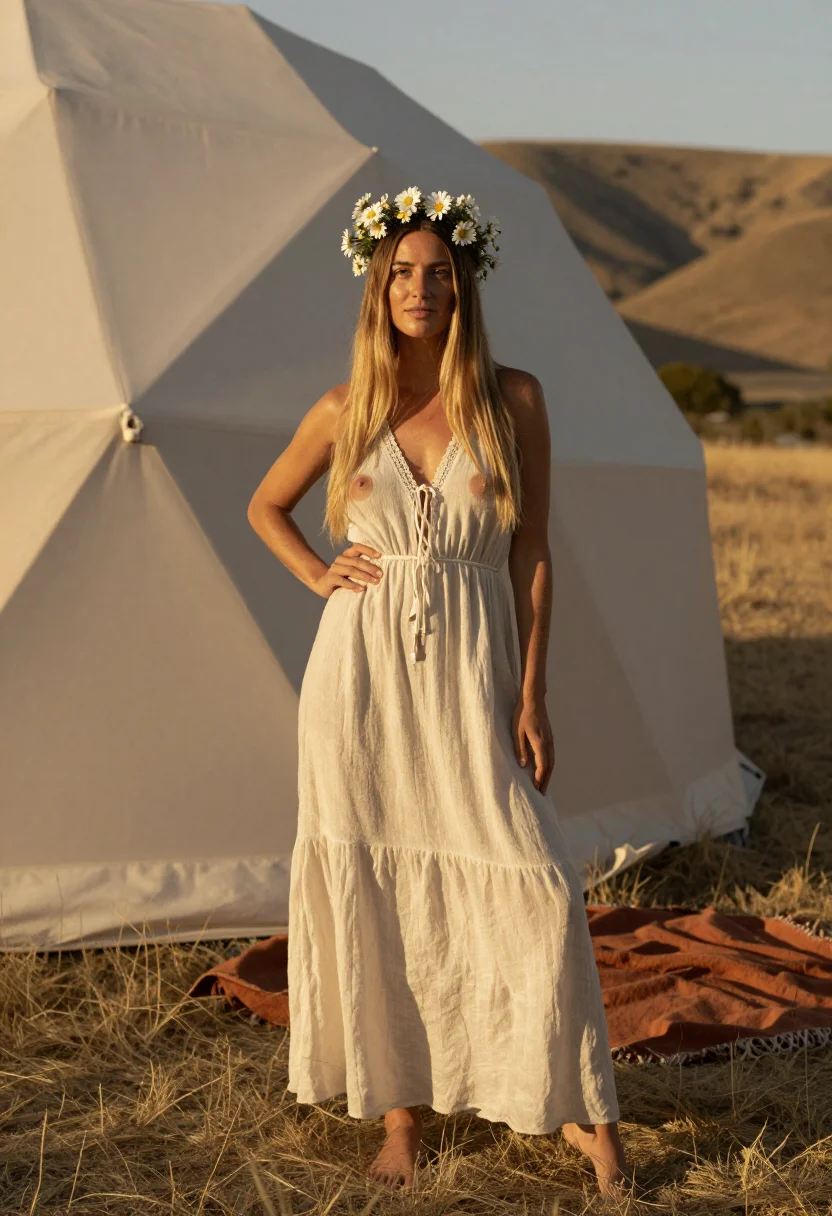
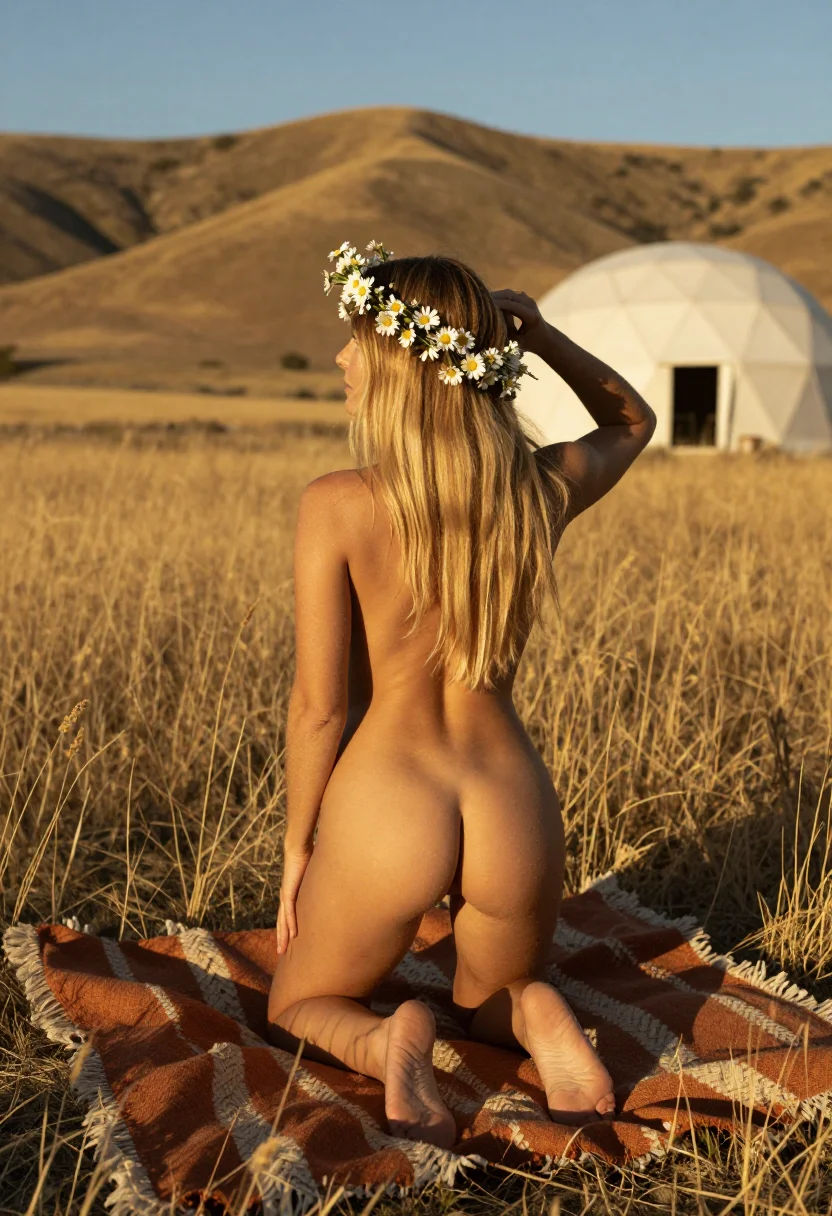
A 1971 California commune: a dome tent, dry gold hills, woven blankets and a guitar in the grass. It borrows the back-to-the-land summer of the early seventies, with the flower crown and the muslin as its costume and the dusty light as its grade.
The arc moves in three clear stages, never mid-change: standing before the dome in the long muslin dress with the laced neck, then in the open doorway with a knitted shawl over the shoulders, then seated cross-legged on the woven blanket in a cotton shirt and wrap skirt, three-quarter view with the gold hills behind. The palette stays fixed: muslin natural, daisy white, dust gold and blanket rust.
Every frame is photographic in construction: warm dusty late sun, cloth and skin texture, never drawn and never animated. Each frame is written as a brief before it is rendered, which is what lets the commune search end on a set that holds one golden afternoon together.
Frequently asked questions
- What is in the AI Hippie Portraits pack?
- Nine frames at a 1971 California commune: a long unbleached muslin dress with a laced neck, a crown of wild daisies, a geodesic dome tent, then a knitted shawl at the doorway, then a cotton shirt and wrap skirt on a woven blanket in the dry grass.
- Are these real photographs or AI-generated?
- AI-generated, built on photographic principles: late gold sun, muslin and skin texture. Never drawn and never animated.
- Is this a real person? What about age and compliance?
- The muse is a composed adult, not a photograph of any real person. If you cast your own face from a selfie, that is your choice and your face. Access requires confirming you are 18 or over.
- How does the look change across the nine frames?
- In three clear steps, never mid-change: the muslin dress worn whole, then the same dress under a knitted shawl at the doorway, then a cotton shirt and wrap skirt on the blanket. The wearer stays dressed throughout.
- Is the flower crown kept through the arc?
- Yes. The daisy crown is the one constant, worn in the first look, adjusted in the doorway and kept in the final frame.
- Do I need to upload a selfie?
- It is optional. One clear front-facing photo casts the muse in your likeness across all nine frames; skip it and the house casts its own.
- How does this compare with other AI image tools?
- Different product. Many AI image tools give one image per prompt with no shared scene. This is a pre-engineered nine-frame series, delivered whole for one payment.
- Can I use the frames once unlocked?
- Personal and creative use. Not for commercial redistribution, not to present as a real person's photograph, and not for use against any individual.
- Who is in the photos?
- A muse you choose. 32 AI faces, none of them a real person.
Who Reaches for the 1971 Commune Register
- People searching hippie portrait or 70s natural portrait who want the whole commune arc
- Photographers after dusty late-afternoon gold over dry grass and canvas
- Costume designers looking at how muslin and a daisy crown read at each stage
- Writers and worldbuilders who need one consistent character across a single summer afternoon
- Anyone building a moodboard around natural art portrait that has to hold one grade across nine images
- Adults curious about AI photography in the 1970s natural register, at an accessible entry point
About Ovid
Ovid is a house of pictures that were never taken. Most AI image tools ship one giant catalog of poses and aesthetics; the output looks like every other generated image on the internet. Ovid goes the other way. Each pack is a single editorial brief — light, styling, scene composed in the grammar of the great fashion editorials — hand-curated against real references and tested before it ships. Free preview before you pay. Packs are one-time. No template generator, no feed. A fashion house, not a catalog.