/mannequin-window
AI Boutique Window Photoshoot
Make it with your museAI Boutique Window Photoshoot
Open this world on the wall, and make it with your muse.
all 9 frames of her, in this world ↓
The Window Register: Plinth, Hook, Glass, Dawn
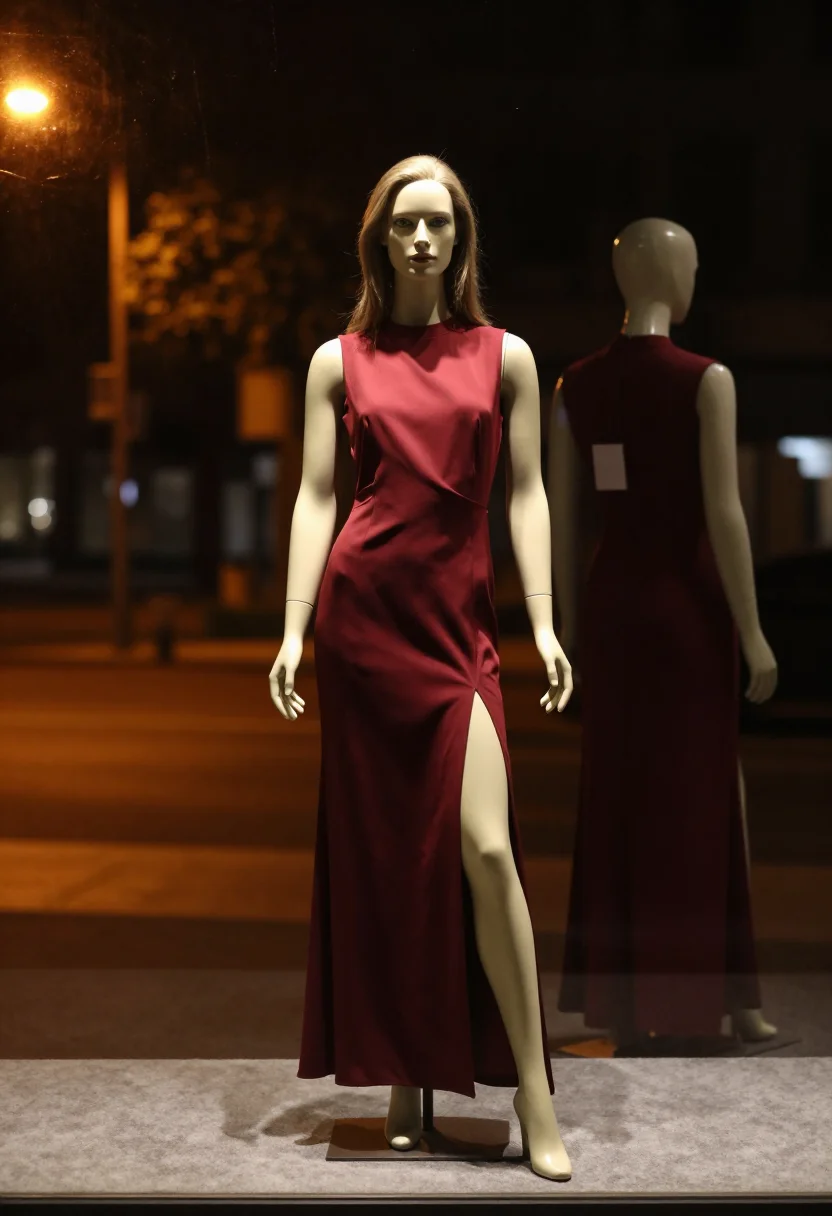
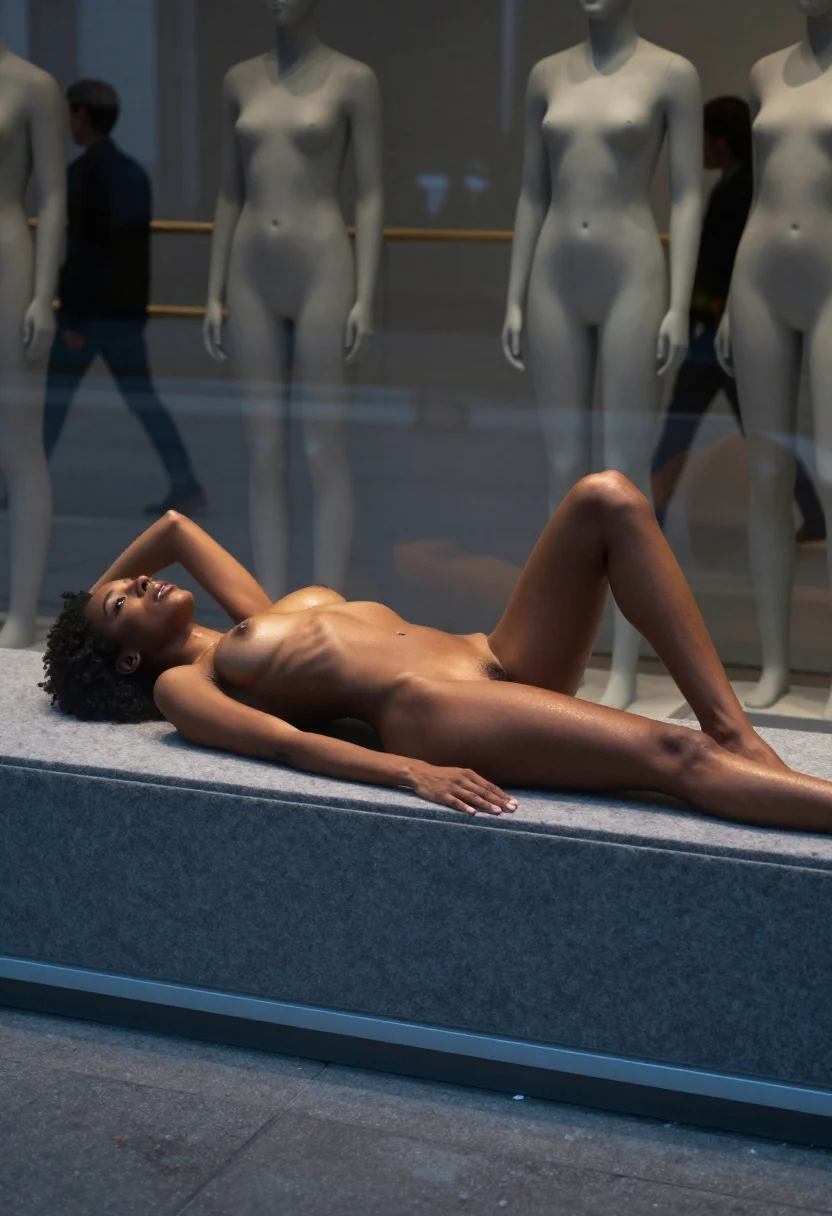
A boutique window is a stage that never closes, and the bodies in it are already posed. This pack puts a living mannequin among them: same dress, same plinth, same held angle, and the only thing separating her from the forms either side is that skin takes light softly and matte plastic does not. The register is stillness, not display — she does not perform for the street, she holds. That is what makes the middle third work: the rail hook and its coat sit beside her, the pose does not change at all, and the window carries on being a window with one living figure standing in it.
Three stages carry the night. It opens dressed: the plinth's felt underfoot, the shop dark behind, street lights pushing orange through the plate glass while the display spots come down hard from above. It moves to the hook: the same dress, the coat on the rail beside her, the mannequins in their dresses either side and the street empty enough that the glass reads as a mirror at its edges. It closes at dawn: seated on the plinth's edge, the sky grey and blue behind the wet pavement, the spots still warm on her, the forms still standing dressed at her back.
Two light sources fight through the whole set, and the fight is the picture. The display spots are near, hard and from above — they carve the collarbone and leave the eyes in shadow, which is exactly how a dressed form is lit in a real window. The street lights are far, warm and low, and they arrive through glass, so they lay a soft second edge along the opposite side and put a faint reflection of the pavement across her. Nothing is lifted from an existing photograph; every frame is written before it is rendered and composed from the first pixel forward.
The public setting is handled narrowly: the commuters in the last third are cropped, turned or blurred past the glass, no face but the muse's is ever depicted, and no one in the frame reacts to her. The house casts a range of muses through this register, and the spots are placed for each so the plinth reads the same way whoever stands on it. All nine frames are photographic in construction and AI-generated in execution — hard overhead key, plate-glass reflection, matte versus soft surfaces rendered from photographic principles rather than drawn.
Frequently asked questions
- What is in the AI Boutique Window Photoshoot pack?
- Nine frames from one boutique window across a single night. She stands on the display plinth in the window's own dress, weight even and one hand raised at a mannequin's angle, close in posture to the matte forms either side of her; beside her the window-dresser's rail hook holds a coat, and she keeps the same stillness in the same dress; at dawn she sits on the plinth's edge, one hand on the felt and the other on her knee. Three frames per stage, one continuous window.
- Does this pack alter a photograph I supply?
- No. Nothing is read out of an existing image. Each frame is written first — the plinth, the forms, the hook, the source of light — and composed from the first pixel forward. Your selfie steers the face the muse wears; it is never the picture being worked on.
- Are these real photographs or AI-generated?
- AI-generated, built on photographic principles. Display spots come down hard from above and carve the shoulders; street lights push warm orange the other way through plate glass and leave a soft second edge; the mannequins' matte surfaces take that light without a single shine, while skin reflects it softly. It reads as a photograph taken from the pavement, not as an illustration.
- Is anyone else in these frames?
- No one is depicted but the muse. The mannequins beside her are matte forms with no faces, and the commuters in the dawn frames pass behind the glass cropped, turned away or thrown out of focus — nobody looks in, nobody reacts, and no other person is shown. The street is scenery, and the window is the only lit thing in it.
- What are the three stages in this pack?
- Night, Dressed — the boutique window after closing, the muse on the plinth in the display's dress among the dressed forms, street lights orange through the glass and the shop dark behind. Night, the Hook — the same dress, the same stillness, the rail hook and its coat beside her, the mannequins either side. Dawn — seated on the plinth's edge, the sky going grey and blue, the pavement wet, the display spots still warm.
- What is the living mannequin idea here?
- A window is already a stage, and the forms in it are already bodies in a pose. This pack takes that literally: the muse stands where a mannequin stands, holds the angle a mannequin holds, and the frames refuse to tell you which is which until the skin gives it away. That is the whole trick of the register — stillness read as display.
- Why the rail hook?
- It is the honest prop of a window dresser's job, and it does the work the register needs: a coat hangs on it at the edge of the frame, and the line of the rail runs up out of the top of the frame, so the window reads as a working shop rather than a set.
- What if my photo isn't great?
- An ordinary phone selfie is enough — front-facing, decent light, nothing professional. The free preview shows you the result on your own face before you pay anything.
- How is this different from a street or exhibition pack?
- This one never leaves the glass. She is inside a lit box on a dark street, and the whole tension is that a window is public by design and untouchable by construction. Nothing happens on the pavement; the pavement just gets light and then gets morning.
- How does this differ from a chat-based image tool?
- Adjacent territory, different product. A chat tool is a conversation you steer one reply at a time. This is a pre-engineered nine-frame series — one window, one night into one dawn — delivered whole for one payment. Better for a coherent set, worse if you want to negotiate every image.
- Can I use the frames once unlocked?
- Personal and creative use. Not for commercial redistribution, not to present as a real person's photograph, and not for use against any individual.
- Is there an age requirement?
- Yes — access requires confirming you are 18 or older. The muse is an adult woman composed from a written brief rather than photographed, so no real person is depicted; if you cast your own face into the set, that likeness is yours and yours only.
- Who is in the photos?
- A muse you choose. 32 AI faces, none of them a real person.
Who Reaches for the Window Register
- Anyone searching shop window photos or living mannequin who wants the scene composed rather than scavenged
- People who want one coherent nine-frame set across a single night instead of prompt results that never match
- Fans of the mannequin window and display register looking for it rendered as photography rather than illustration
- Photographers studying a hard overhead display spot fought by warm street light through plate glass
- Visual merchandisers and window dressers looking at how a plinth, a rail hook and matte forms build a frame
- Writers and worldbuilders who need one consistent adult character through a single night into dawn
- Adults curious about the editorial register of AI photography at an accessible entry price
About Ovid
Ovid is a house of pictures that were never taken. Most AI image tools ship one giant catalog of poses and aesthetics; the output looks like every other generated image on the internet. Ovid goes the other way. Each pack is a single editorial brief — light, styling, scene composed in the grammar of the great fashion editorials — hand-curated against real references and tested before it ships. Free preview before you pay. Packs are one-time. No template generator, no feed. A fashion house, not a catalog.