/poncho
AI Poncho Photos
Make it with your museAI Poncho Photos
Open this world on the wall, and make it with your muse.
all 9 frames of her, in this world ↓
The Poncho Register: One Garment, Bleached Adobe, and High Noon
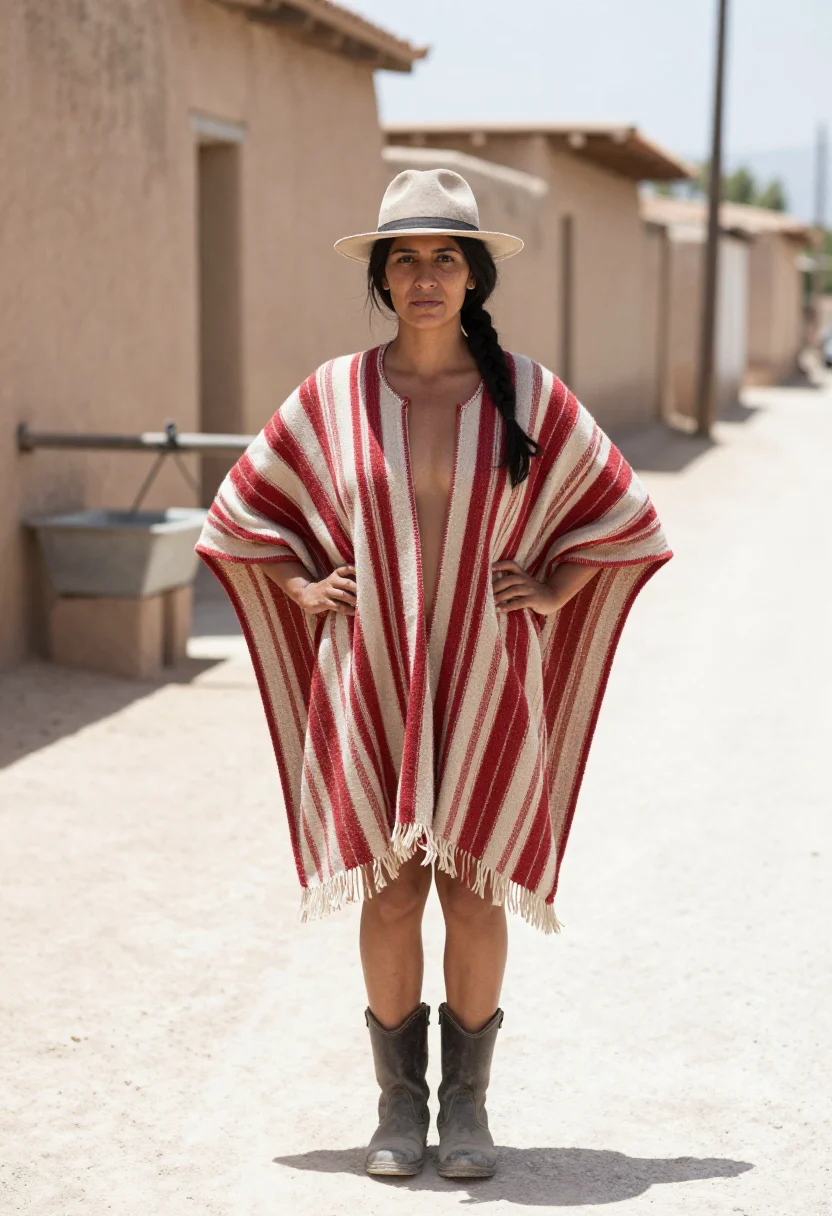
The poncho pack takes its look from the spaghetti western's own visual grammar — a lone figure at the street's dead centre, a hat pulled low, adobe walls bleached past any color. The woven wool poncho is the one garment, worn through the whole set, and it carries the wardrobe the way it does in the genre's own iconography.
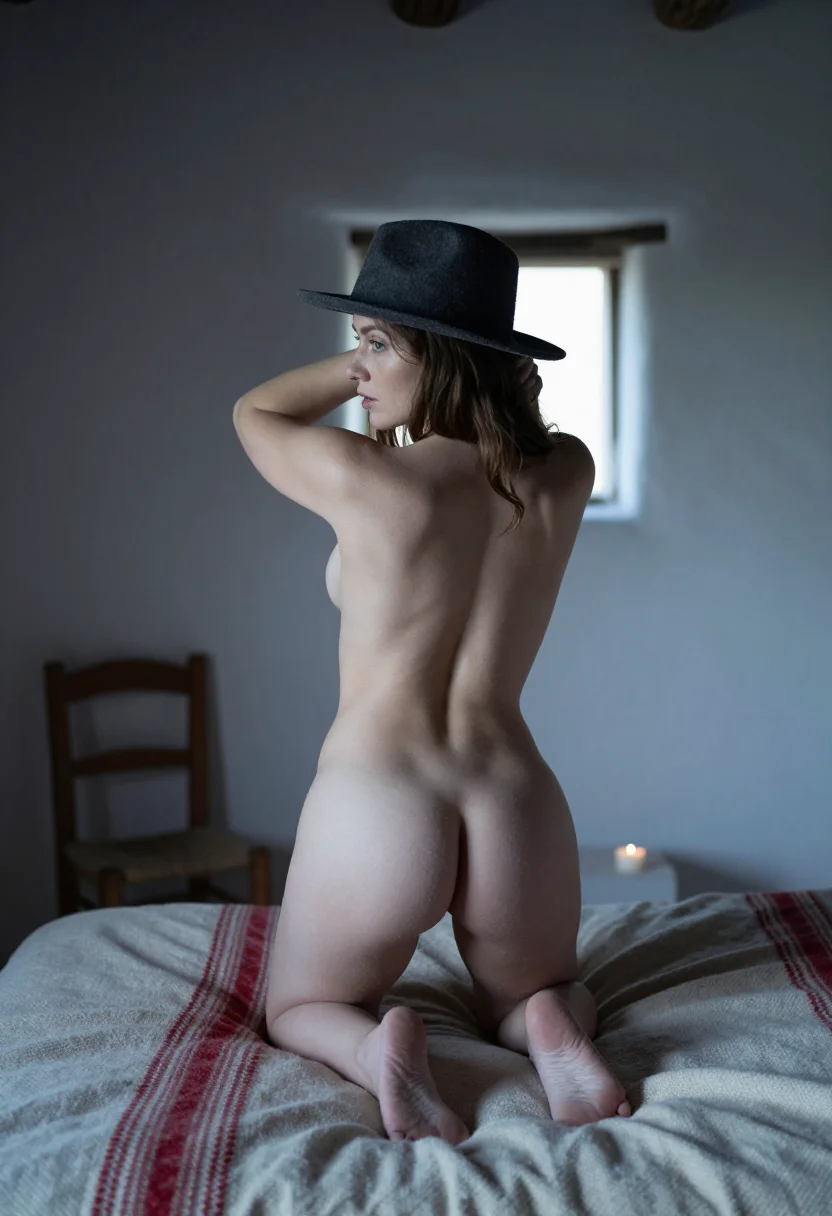
Three lights carry the sequence and each belongs to a different part of the town. The street is shot straight overhead — shadowless, flat, heat shimmer visible at its far end — the hardest and least forgiving light in the whole pack. The cantina's doorway cuts that glare against its own cool shade along one sharp threshold line. The adobe room closes the set entirely differently: a cool interior blue, broken only by a single shutter slit of the same white noon now reduced to one narrow band on the wall.
Wardrobe holds to one arc: the poncho and the hat pulled low in the street, the poncho's fringe catching the light in the cantina's shade, and the adobe room's cool blue at the close, with the hat in her hand. Pose craft favors a square stance with both hands at the hips beneath the poncho's edge, a shoulder against the doorpost, and the closing seat framed from the head end at three-quarters.
All nine frames are photographic in construction and AI-generated in execution — shadowless noon glare, adobe wall texture, wool and skin rendered from photographic principles rather than drawn or painted. No real desert town and no real photograph of a real woman were used to produce any of it.
Frequently asked questions
- What is in the AI Poncho Photos pack?
- Nine frames across a spaghetti-western street. In the adobe street at high noon, a woven wool poncho and the hat pulled low, boots planted square in the dust. In the cantina's shade, the poncho's fringe catching the light as she leans on the doorpost. In the adobe room's cool blue, seated on a coarse blanket with the hat in her hand and the poncho wrapped close. Three frames per stage, one payment for the set.
- Are these real photographs or AI-generated?
- AI-generated, built on photographic principles. The street reads in a straight-overhead sun that casts no shadow at all — flat, shadeless, bleaching the adobe walls white with heat shimmer at the street's end; the cantina interior cuts a hard line between that glare and its own dim shade; the adobe room runs on a single shutter slit of white noon against cool interior blue. Wool, adobe plaster and skin each answer those three lights differently. It reads as a photograph shot on a real desert street, not as an illustration.
- Why does the poncho matter to the register?
- Because it is the whole wardrobe. The lone rider's woven poncho is worn from the first frame to the last, and the set is carried by the light and the stance rather than by any change of clothes.
- How is this different from the Ghost Town pack?
- Ghost Town is an abandoned street with nobody left in it at all. This pack keeps the town alive — a cantina with a clay jug, a hitching rail, a water trough — and the mood comes from the lone rider in her poncho rather than from the town being empty. Different story, same hard noon light.
- Why does the light shift from white to cool blue?
- Because the set follows her away from the street. The street and cantina frames both read in the same relentless noon, one shadowless and one split by shade; the adobe room closes the set in a different register — cool interior blue cut by one shutter slit of the same white noon, now filtered down to a single narrow line on the wall.
- Do I need to upload a selfie?
- It is optional. One clear front-facing photo casts the muse in your likeness across all nine frames; skip it and the house casts its own. Your selfie steers the face — it is never the image being altered.
- How does this compare with a prompt-box image generator?
- Different workflow. A prompt box asks you to write each frame yourself; this is a pre-engineered nine-frame series — one street, three situations, one unbroken noon — delivered whole for one payment. Better for a coherent set, worse if you want to negotiate every image.
- Can I use the frames once unlocked?
- Personal and creative use. Not for commercial redistribution, not to present as a real person's photograph, and not for use against any individual.
- Is there an age requirement?
- Yes. Access requires confirming you are 18 or over. The muse is composed from a written brief rather than photographed, so she is not a real person; if you cast your own face into the set, that likeness is yours and yours only.
- Who is in the photos?
- A muse you choose. 32 AI faces, none of them a real person.
Who Reaches for the Poncho Register
- People searching for a poncho photo who want the spaghetti-western look at its full length
- Photographers studying a straight-overhead shadowless sun against a hard cantina threshold line
- Costume people looking at how a woven wool poncho reads at the street, the cantina and the adobe room
- Writers and worldbuilders who need one consistent lone-rider character across a single desert street
- Anyone building an adobe town moodboard that has to hold one grade and three distinct light logics across nine images
- Collage and matte artists who need photographic-quality bleached-adobe material rather than studio glamour
- Adults curious about the spaghetti-western register of AI photography, in wool rather than a corset or a duster
About Ovid
Ovid is a house of pictures that were never taken. Most AI image tools ship one giant catalog of poses and aesthetics; the output looks like every other generated image on the internet. Ovid goes the other way. Each pack is a single editorial brief — light, styling, scene composed in the grammar of the great fashion editorials — hand-curated against real references and tested before it ships. Free preview before you pay. Packs are one-time. No template generator, no feed. A fashion house, not a catalog.