/repair-shop
AI Android Repair Bench Photoshoot
Make it with your museAI Android Repair Bench Photoshoot
Open this world on the wall, and make it with your muse.
all 9 frames of her, in this world ↓
The Repair Bench Register: The Workshop After Hours
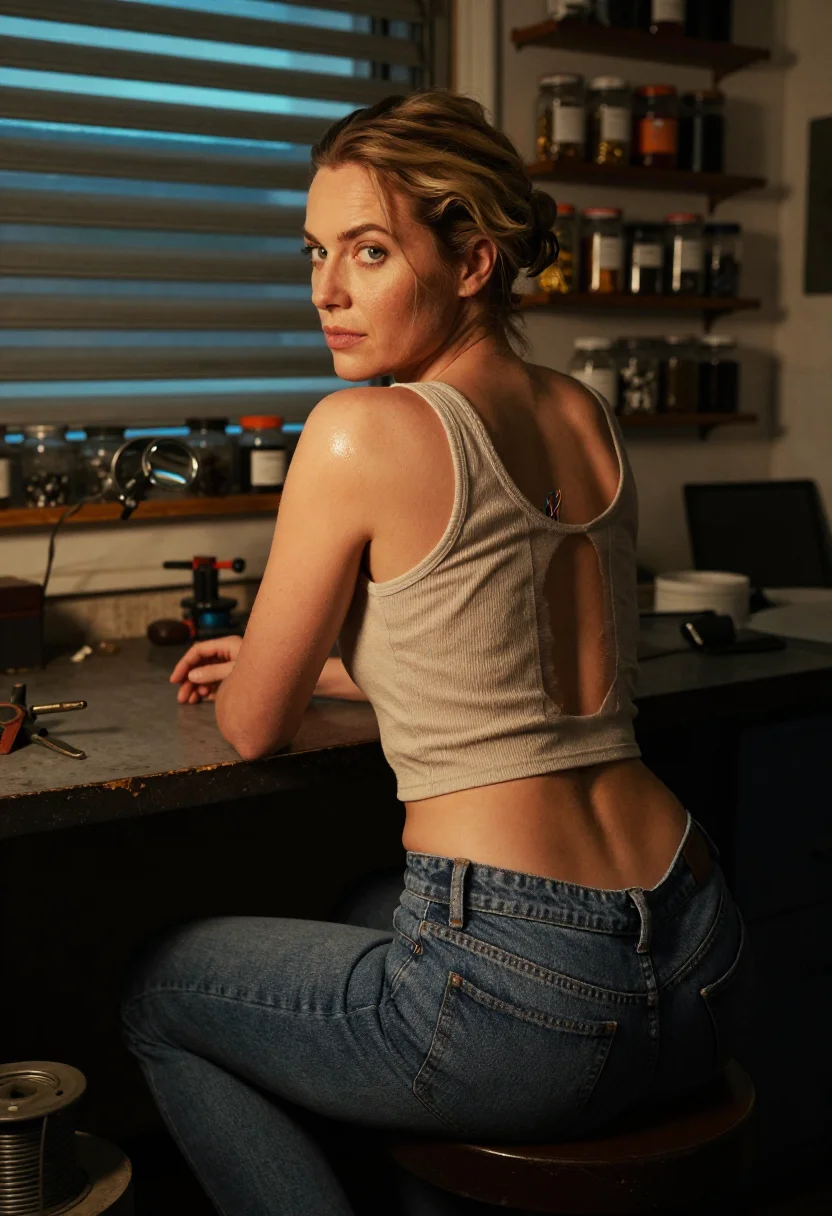
One room, and everything in it has been used. A scarred workbench, a vice with a jacket hung on it, jars of parts, a magnifier arm, a coil of solder, an iron in its stand, and a roll shutter with the alley's neon leaking through the slats. The register is available-light photography in a small space — nothing brought in, nothing arranged, the subject sitting where the work put her. She is calm in it: a technician at home in a back-alley workshop.
Three stages run the set. On the stool: a tank top, the jacket on the vice, a wiring harness in her lap under the magnifier arm. At the bench: the soldering iron in her hand, the warm lamp landing on her fingers and the joint, one forearm resting on the bench edge. Then standing under the shutter: the iron cooling in its stand, the neon crossing the bench, her jacket still on the vice and the outfit unchanged.
The workshop vocabulary is kept to three objects — the coloured wiring harness, the magnifier arm and the soldering iron. The wiring is bundled, not schematic; nothing is diagrammed. Between them the skin renders as skin under a warm tungsten lamp, which is the contrast the whole pack is built on.
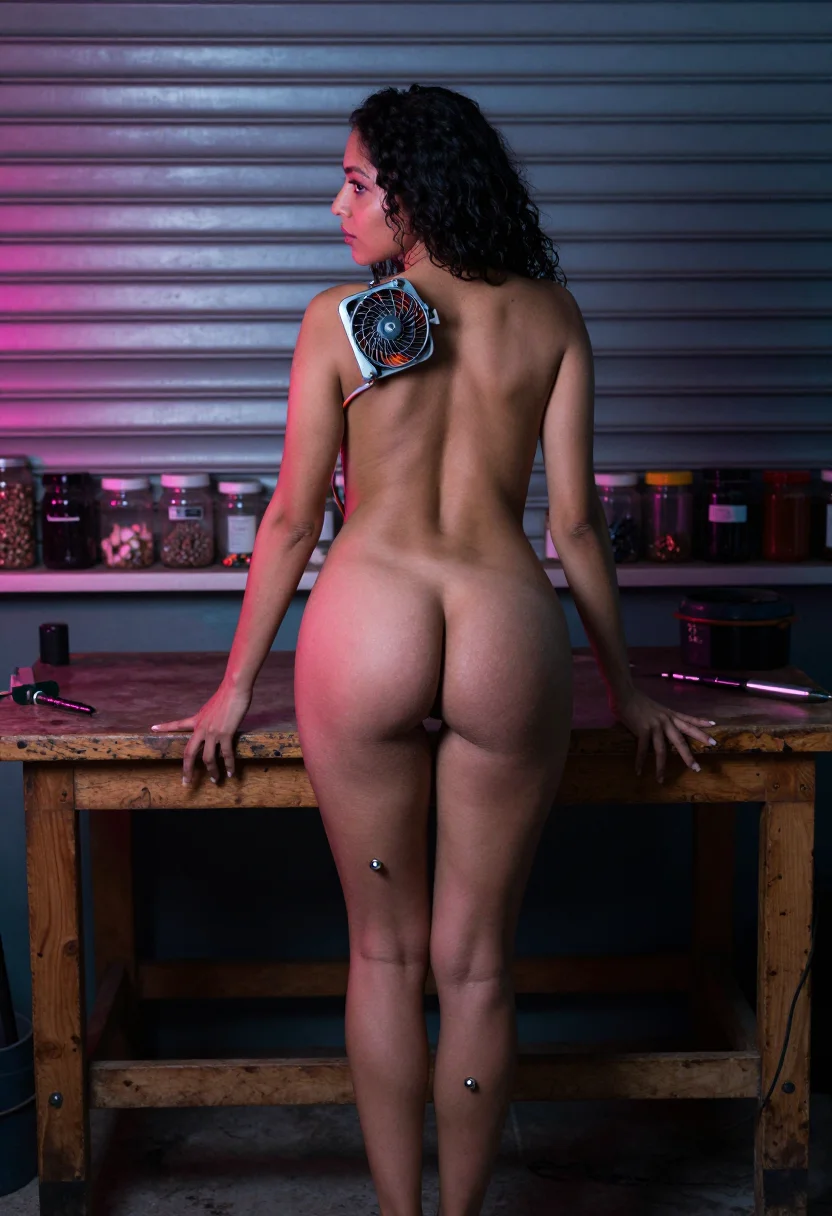
Two lights fight across all nine frames and never stop: a bench lamp, low and orange and close, with a hard falloff into the dark; and cold neon through the shutter behind, laid across the floor and bench as pink and blue bands. Warm front planes, cold edges, black past the lamp's reach — and no legible text on any sign, deliberately. All nine frames are photographic in construction and AI-generated in execution: specular on wiring insulation and metal, shadow edge, skin and denim rendered from photographic principles, not drawn and not animated. No real person was photographed to make any of them.
Frequently asked questions
- What is in the AI Android Repair Bench Photoshoot pack?
- Nine frames from one back-alley workshop, in three stages. Three on the technician's stool in a tank top with her jacket hung on the vice, a wiring harness in her lap under the magnifier arm. Three at the bench with a soldering iron, the warm lamp on her hands and the work. Three standing under the shutter, the neon crossing the bench, the iron cooling in its stand. Three frames per stage, one payment for the set.
- Are these real photographs or AI-generated?
- AI-generated, built on photographic principles. Two sources fight across every frame: a bench lamp low and orange from one side, warm and close with a hard falloff, and cold neon through the shutter slats as bands of magenta and blue across the floor and the bench. It reads as available-light photography in a small room, not as an illustration.
- What is actually being repaired?
- Nothing is stated and nothing needs to be. A harness of coloured wiring sits in her lap, the iron is hot on the bench, and the work is a small job in a long day. The register is the quiet of the workshop, not the procedure.
- How much of the technology is shown?
- Rationed to three things: the coloured wiring harness, the magnifier arm and the soldering iron. Nothing else is diagrammed. She is an adult woman in a workshop, not a cutaway drawing — the skin reads as skin and the warm lamp lands on it as skin.
- What is she wearing, stage by stage?
- A tank top, a denim jacket and dark trousers, worn in every frame. The jacket hangs on the vice through the sequence; the rest of the outfit stays as it is. Each stage is a settled state, never a half-motion.
- Is there any readable text in the neon?
- No. The shutter's neon is colour and bands only — pink and blue across the floor, no legible sign, no shop name, no slogan anywhere in the set. It keeps the eye on the bench and away from the street.
- How is this different from the Cyborg Alley pack?
- Cyborg Alley is the city outside this door — neon rain, a stairwell, a rooftop, a street. This one never leaves the shop: one room, one bench, one lamp, and a woman at work. Cyborg Alley is the street; this is the back room next to it.
- How is this different from the Synthetic Skin pack?
- Synthetic Skin is manufacture — a clean lab, flat white light. This is maintenance, years later: a scarred bench, jars of parts, warm lamp and cold neon. Same workshop vocabulary, a different point in her working life.
- How is the bench framed?
- From the side, at three-quarters, along the bench's edge — the composition looks down the bench rather than up at her, and no tool is pointed at the lens. The last third holds the same available-light register as the first two.
- How does this compare with a chat-based AI image tool?
- Different product. A chat tool steers one turn at a time; a prompt box refines image by image. This is a pre-engineered nine-frame series — one shop, three stages, one two-source lighting logic — delivered whole for one payment.
- Can I use the frames once unlocked?
- Personal and creative use. Not for commercial redistribution, not to present as a real person's photograph, and not for use against any individual.
- Is there an age requirement?
- Access requires confirming you are 18 or over. The muse is an adult woman composed from a written brief rather than photographed, so she is not a real person; if you cast your own face into the set, that likeness is yours and yours only.
- Who is in the photos?
- A muse you choose. 32 AI faces, none of them a real person.
Who Reaches for the Repair Bench Register
- People searching for an android repair bench portrait who want the after-hours workshop register
- Photographers studying how a warm soldering glow and cold neon through the shutter meet on the same figure
- Writers and worldbuilders who need one synthetic woman across a coherent nine-frame sequence in a single room
- Anyone building a cyberpunk workshop moodboard that has to hold one two-source grade across the set
- Collage artists who need photographic-quality neon-and-tungsten material rather than studio glamour
- Science-fiction illustrators after available light in a small practical space
- Adults curious about the robot girl workshop register of AI photography
About Ovid
Ovid is a house of pictures that were never taken. Most AI image tools ship one giant catalog of poses and aesthetics; the output looks like every other generated image on the internet. Ovid goes the other way. Each pack is a single editorial brief — light, styling, scene composed in the grammar of the great fashion editorials — hand-curated against real references and tested before it ships. Free preview before you pay. Packs are one-time. No template generator, no feed. A fashion house, not a catalog.