/shag-carpet
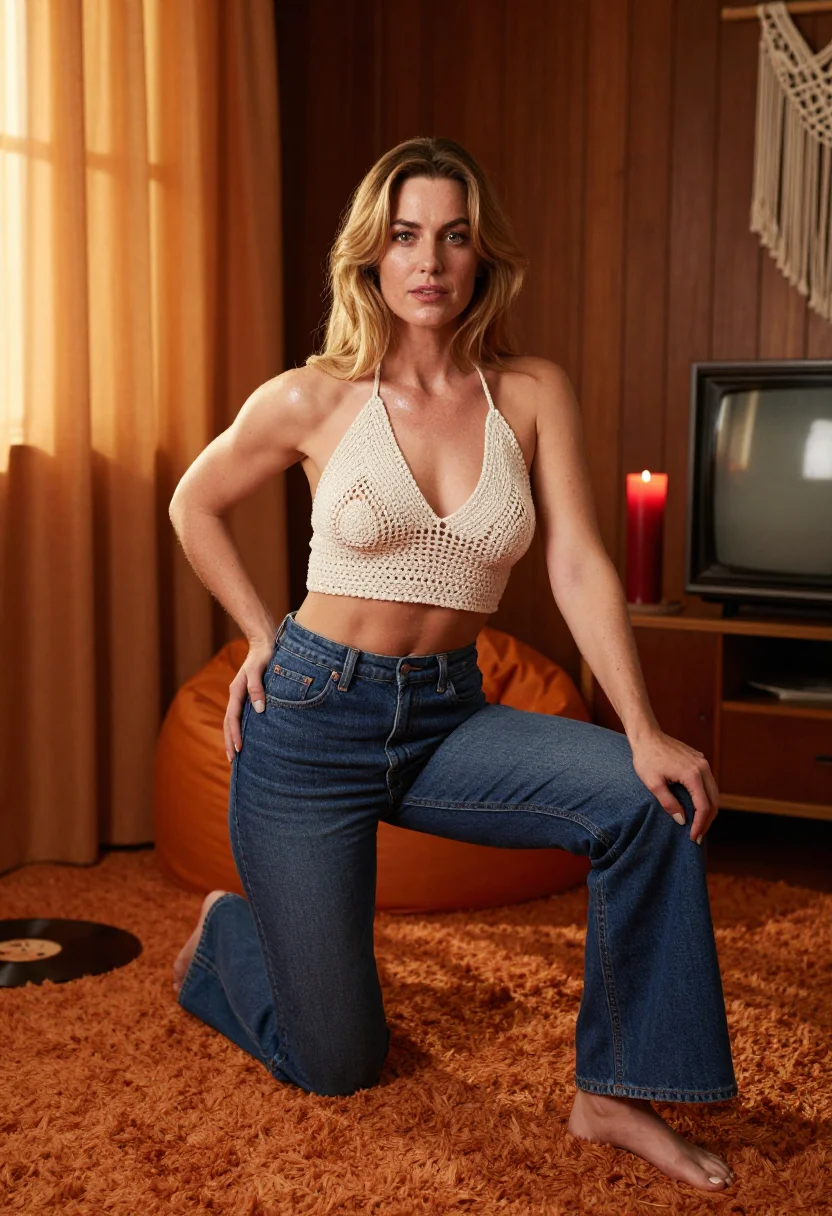
AI 70s Living Room Portrait

Make it with your museAI 70s Living Room Portrait
Open this world on the wall, and make it with your muse.
all 9 frames of her, in this world ↓
The 70s Register: Everything Lands on the Shag
This is the 70s living room — wood panelling, a shag carpet, a lava lamp, a console television showing static — the era's whole private world. She sits on the orange shag first, a crochet halter top and high-waisted flares, in socks on the rug, feathered hair, one hand on the shag and the TV's static grey behind her. Next she moves to the beanbag with her weight back, the curtains' orange light on her collarbones, the flares still on. By the third frame she is stretched on the shag rug before the console TV, one arm under her head, the halter and flares kept on.
Light stays warm and analog throughout — the lava lamp's red-orange, curtained afternoon sun, the TV's blue static at the end. All nine frames are photographic in construction and AI-generated in execution — the television shows static only, no text on any record sleeve, nothing borrowed from a real home or a real person. The 70s living room search ends here, honestly. Every frame is written before it is rendered, and the room is imagined whole, not photographed from any real house.
Frequently asked questions
- What's the difference between the free preview and the paid pack?
- The preview is one photo from your uploaded face, shown live in about 15 seconds so you can judge the result before paying. The paid pack is nine photos in the same 70s register, ready in about 45 seconds.
- What is in the AI 70s Living Room Portrait pack?
- Nine frames in one wood-panelled living room: seated on the shag carpet in a crochet halter and high-waisted flares, seated in a beanbag with the flares open at the hips, and lying on the shag before a console TV showing static.
- Are these real photographs or AI-generated?
- AI-generated, built on photographic principles. The lava lamp's red-orange glow, afternoon light through orange curtains, and the TV's static-blue all answer skin the way a real 70s living room would. Nothing is a photograph of a real home or a real person.
- Do I need to upload a selfie?
- It's optional. One clear front-facing photo casts the muse in your likeness across all nine frames; skip it and the house casts its own. Your selfie steers the face — it is never an image that gets altered.
- What if my photo isn't great?
- The free preview tells you in fifteen seconds. One clear, front-facing photo is usually enough; you'll see exactly how the likeness lands before paying for the full nine.
- What props and wardrobe are in the set?
- A crochet halter top, high-waisted flares, a lava lamp, a macramé hanging, a record sleeve with no legible text, and a console TV showing static, nothing else.
- What makes this set different from a single image?
- One 70s room, one afternoon, one woman in it — nine frames delivered whole for one payment, built to read as one scene.
- Can I use the frames once unlocked?
- Personal and creative use. Not for commercial redistribution, not to present as a real person's photograph, and not for use against any individual.
- Is there an age requirement?
- Access requires confirming you are 18 or over. The muse is composed from a written brief rather than photographed, so she is not a real person; if you cast your own face into the set, that likeness is yours and yours only.
- Who is in the photos?
- A muse you choose. 32 AI faces, none of them a real person.
Who Reaches for the 70s Register
- People searching for a 70s portrait or retro living room photo who want the shag-carpet register rather than a generic vintage shot
- Photographers studying how a lava lamp's glow and static-blue TV light read differently across one set
- Costume and fashion people looking at how a crochet halter and flares read across a single afternoon
- Writers and worldbuilders who need one consistent character across a single 70s afternoon at home
- Anyone building a shag carpet or lava lamp moodboard that has to hold one grade across nine images
- Collage artists who need photographic-quality 70s-interior material rather than studio glamour
- Adults curious about the 70s living-room register of AI photography at an accessible entry price
- Fans of the retro-living-room look who want a composed, not photographed, take on it
About Ovid
Ovid is a house of pictures that were never taken. Most AI image tools ship one giant catalog of poses and aesthetics; the output looks like every other generated image on the internet. Ovid goes the other way. Each pack is a single editorial brief — light, styling, scene composed in the grammar of the great fashion editorials — hand-curated against real references and tested before it ships. Free preview before you pay. Packs are one-time. No template generator, no feed. A fashion house, not a catalog.