/showroom-model
AI Display Model Portrait
Make it with your museAI Display Model Portrait
Open this world on the wall, and make it with your muse.
all 9 frames of her, in this world ↓
The Showroom Register: A Display Model, After Closing
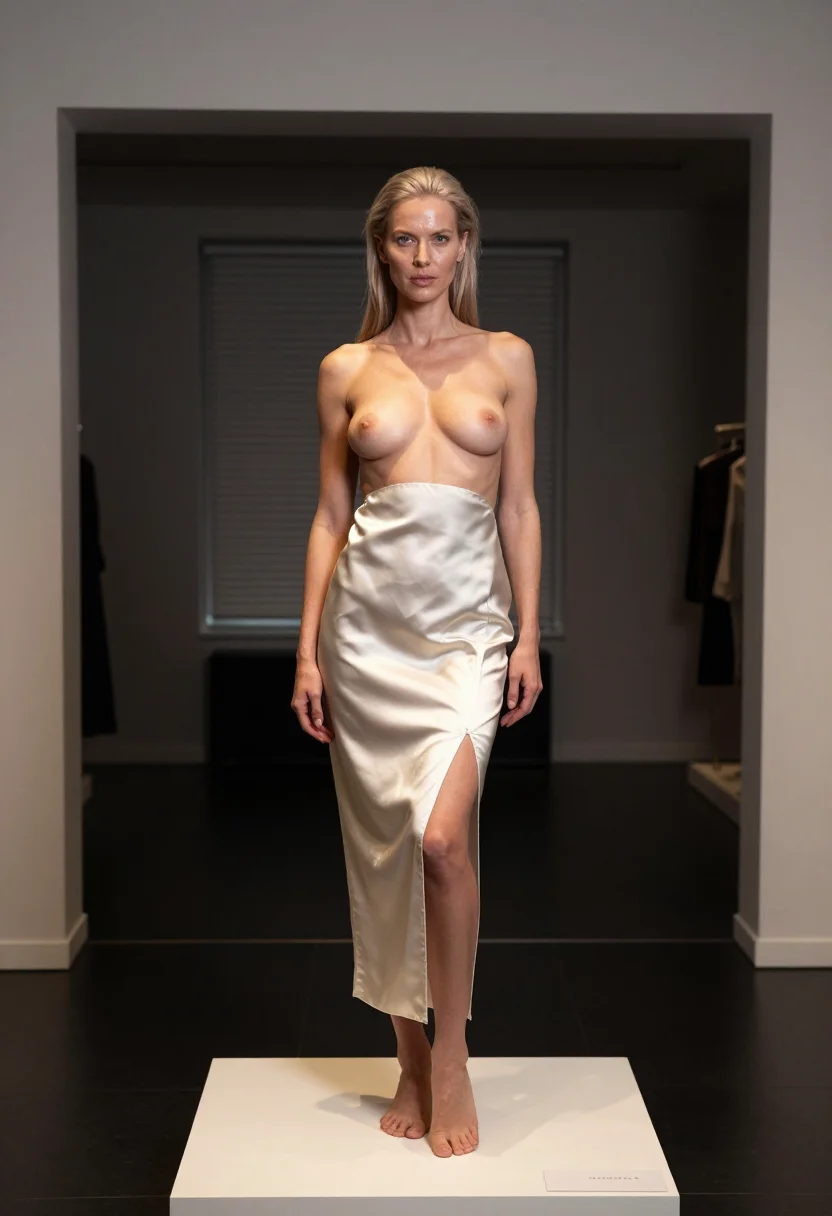
The conceit is a boutique that sells the clothes on the woman standing in it. A rotating plinth, three spotlights aimed down at it, a rail hook overhead, a blank spec placard at the plinth's foot, and beyond the light a dark shop floor with the window blinds down. She is a display model, which makes being looked at her ordinary condition rather than an event — and that is what the register borrows from commercial lookbook photography: composure, weight over one hip, hands at her sides, nothing performed for the lens.
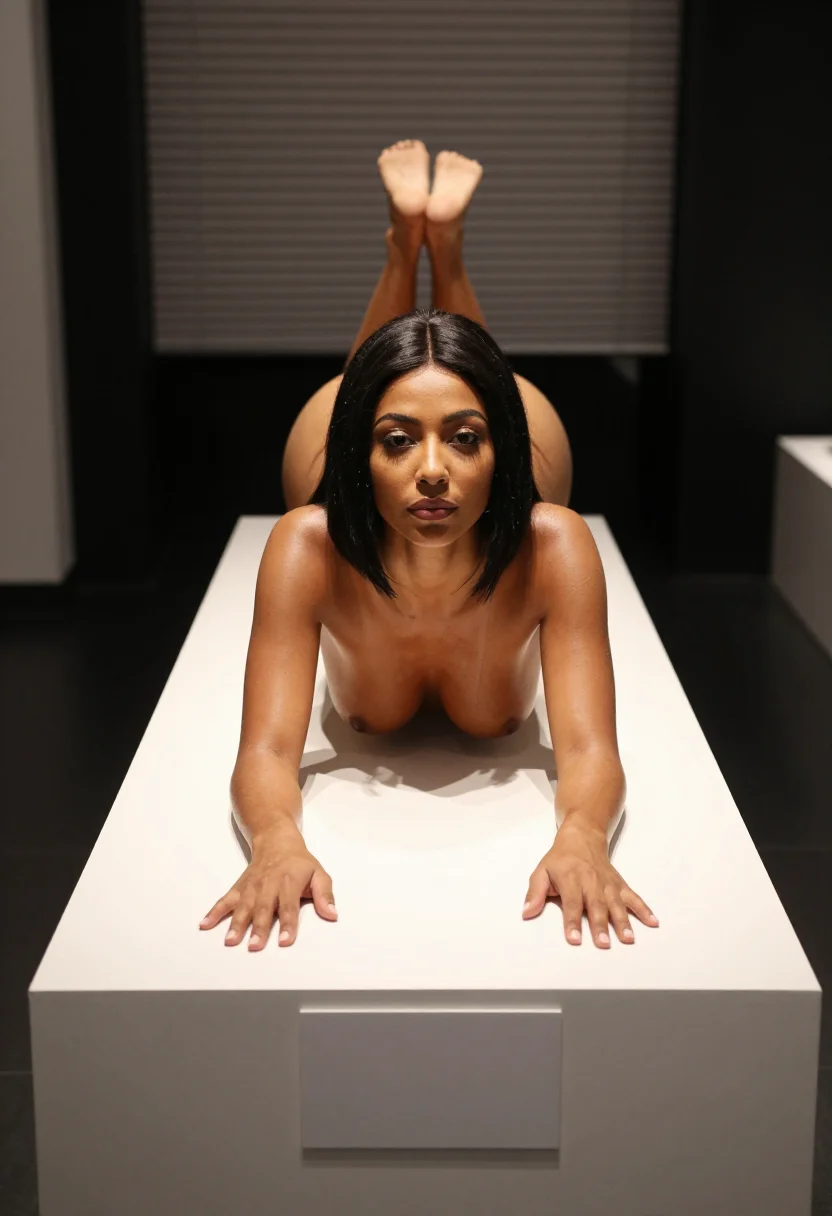
The set runs in three stages and the satin goes with them. First, the sheath along the seam line, the fabric taking the spots as a hard specular streak at the shoulder blade. Then the satin coat lifted from the rail hook and held over one arm, one shoulder panel showing the joint's chrome sphere. Then the plinth after hours: seated on its edge, one leg along it, the sheath on, the shop dark. No hand ever enters the frame. The hook is the only mover, and that is the point.
The mechanical vocabulary is rationed to three nouns — a seam line, a shoulder panel, a ball-joint sphere — one per limb, worn like jewellery rather than diagrammed. She is not segmented and she is not plastic; the skin renders as skin, matte and even, and the joint is the single place the build shows.
Three light states carry the sequence. Standing under three hard spotlights with the plinth's white surface throwing a softer light back up under the jaw. Then the same spots harder from directly above, the rail hook's line running out of frame, the shop's floor black beyond. Then the plinth's own light alone, from below, after closing — the dimmest of the three. Every frame is photographic in construction and AI-generated in execution, rendered from photographic principles, not drawn and not animated. No real person was photographed to make any of them.
Frequently asked questions
- What is in the AI Display Model Portrait pack?
- Nine frames from one boutique showroom, in three stages. Three on the display plinth under three spotlights, a satin sheath along the seam line, standing in the plinth's slow turn. Three with a satin coat lifted from the rail hook and held over one arm, the sheath still on, one shoulder panel showing the joint's chrome sphere. Three seated on the plinth's edge after hours, the sheath on, the shop dark behind. Three frames per stage, one payment for the set.
- Are these real photographs or AI-generated?
- AI-generated, built on photographic principles. Three hard spotlights from above give a crisp shadow edge under the jaw and along the collarbone; the plinth's white surface bounces a soft second light up from below; satin catches the spots as a specular streak at the shoulder blade. It reads as a shop's own lookbook photography, not as an illustration.
- Is she a robot, a mannequin, or a woman?
- A gynoid — an adult woman built as a display model, which is the whole conceit. The mechanical vocabulary is deliberately sparse: a seam line down the back, one shoulder panel over a chrome sphere joint, nothing else. The skin reads as skin and the joints read as the one place the build shows.
- What is she wearing?
- A satin sheath, kept on in every frame. In the first stage it sits along the seam line, the fabric catching the spotlights at the shoulder blade. In the second, the satin coat hangs from the rail hook above her and she holds it over one arm. In the last, the sheath is worn seated on the plinth's edge. No hands appear anywhere in the set — the hook is the only thing that moves.
- Why is the spec placard blank?
- Because a display model with a filled-in placard becomes a product with a name and a number, and the register here is the moment after the shop stops selling anything. The placard stands at the plinth's foot in every frame, blank, the shop dark past the reach of the light.
- How is this different from the Synthetic Skin pack?
- Synthetic Skin is the making — the lab bench, the chrome frame, the skin sleeve being drawn on over it, the last seam closing at the sternum. This one is the display: she is already finished and fitted, and the set is about being looked at through glass. Same synthetic-woman register, a different part of her life.
- How is this different from the Doll Joints pack?
- Doll Joints is the ball-jointed doll register — porcelain-smooth skin, visible sphere joints at both elbows and both knees, a maker's shelf and bench. Here the mechanical detail is nearly hidden: one seam, one shoulder panel, one joint. Doll Joints is about being made by hand; this one is about being displayed.
- Why is there no hand in any frame?
- Because the coat is lifted by machine. The rail hook holds it and the plinth turns her under the lights — nobody in the shop is doing either. It keeps the set on the display register, and it is why the middle stage reads as mechanism rather than as a scene with someone else in it.
- Can I use these as reference for a character or a story?
- Yes, and it is one of the things a nine-frame set is good for: one consistent synthetic woman, one location, three stages and three lighting states. Writers, worldbuilders and concept people get a coherent character sheet rather than nine unrelated images.
- What makes this set different from a single image?
- One showroom, three stages, three lighting logics — delivered whole for one payment, built to read as one scene rather than nine unrelated pictures.
- Can I use the frames once unlocked?
- Personal and creative use. Not for commercial redistribution, not to present as a real person's photograph, and not for use against any individual.
- Is there an age requirement?
- Access requires confirming you are 18 or over. The muse is an adult woman composed from a written brief rather than photographed, so she is not a real person; if you cast your own face into the set, that likeness is yours and yours only.
- Who is in the photos?
- A muse you choose. 32 AI faces, none of them a real person.
Who Reaches for the Display Model Register
- People searching for a display model photo who want the lookbook register rather than a robot illustration
- Photographers studying how three hard overhead spotlights and a bright bounce surface underneath fight each other across satin and skin
- Writers and worldbuilders who need one consistent synthetic woman across nine coherent frames instead of nine unrelated ones
- Concept and costume people looking at how a satin sheath and coat behave worn, hung from a hook, and held
- Anyone building a gynoid display moodboard that has to hold one grade across the whole set
- Collage artists who need photographic-quality synthetic-woman material rather than studio glamour
- Science-fiction illustrators after a mechanical vocabulary rationed to three nouns rather than a full diagram
- Adults curious about the display-model register of AI photography
About Ovid
Ovid is a house of pictures that were never taken. Most AI image tools ship one giant catalog of poses and aesthetics; the output looks like every other generated image on the internet. Ovid goes the other way. Each pack is a single editorial brief — light, styling, scene composed in the grammar of the great fashion editorials — hand-curated against real references and tested before it ships. Free preview before you pay. Packs are one-time. No template generator, no feed. A fashion house, not a catalog.